
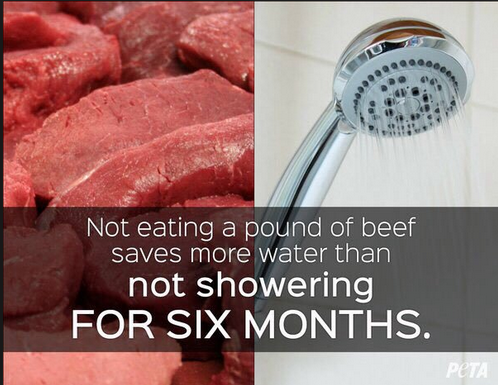
When our food preferences begin to become a threat to our planet and ourselves, the food choices we make, cease to be a matter of personal preference. The writing is on the wall now as rightly interpreted by The United Nations Environment Program (UNEP) which dubbed beef as a “climate harmful meat.” Prof Gidon Eshel of Bard College in New York and who led a research on beef’s impact says “The big story is just how dramatically impactful beef is compared to all the others,” Eshel’s team analyzed how much land, water and nitrogen fertilizer was needed to raise beef and compared this with poultry, pork, eggs and dairy produce. Beef had a far greater impact than all the others because as ruminants, cattle make far less efficient use of their feed.
The benefits associated with alternatives to beef provide sufficient reasons to move away from beef. Black beans or rice, when soaked and cooked doubles in volume, whereas ground beef loses volume. For instance 2 ounces of black beans or rice when cooked increases to 8 ounces. On the other hand 10 ounces of ground beef results only in 8 ounces after cooking.
The yield per acre is 1200 pounds or 545 kg per acre for black beans and 6100 pounds or 2770 kg for brown rice. For beef it is only 25 to 250 pounds or 12 to 114 kg per acre. It has been estimated that the number of people fed in a year per hectare is 22 for potatoes, 19 for rice and just 1 for beef.
The contemporary media has now taken over the baton from the scientific community to press for a global reduction of beef. In her article, “Here’s how much giving up beef helps — or doesn’t help — the planet” in Washington Post, Tamar Haspel says “You’ve heard the eat-less-meat advice and you’ve probably even heard that beef is the biggest offender. There’s plenty of evidence bolstering that position”.
In its article, “Giving up beef will reduce carbon footprint more than cars, says expert”, The Guardian highlights a study showing red meat dwarfed others with regard to environmental impact, using 28 times more land and 11 times water for pork or chicken. When compared to staples like potatoes, wheat, and rice, the impact of beef per calorie is even more extreme, requiring 160 times more land and producing 11 times more greenhouse gases.
However it is not beef alone that is responsible for the situation although it contributes more severely to the crises. The article, “Comparative analysis of environmental impacts of agricultural production systems, agricultural input efficiency, and food choice” published in Environmental Research Letters notes that plant based foods have the lowest environmental impacts; eggs, dairy, pork, poultry, non-trawling fisheries, and non-recirculating aquaculture have intermediate impacts; and ruminant meat has impacts approximately 100 times those of plant-based foods.
The WHO expects annual meat production to increase from 218 million tons in 1997-1999 to 376 million tons by 2030. The organization adds, growing demand for livestock products is likely to have an undesirable impact on the environment. For example, there will be more large-scale, industrial production, often located close to urban centers, which brings with it a range of environmental and public health risks. “The biggest intervention people could make towards reducing their carbon footprints would not be to abandon cars, but to eat significantly less red meat,” said Prof Tim Benton of the University of Leeds.
With regard to health too, A 2016 article in the journal Nature, “Global diets link sustainability and human health”, indicates that a fish-based diet reduces the risk of type II diabetes by 25 per cent, improving to 40 per cent for full-blown vegetarians. It is also perceived that meat-rich diets might be a contributor to coronary heart disease, type II diabetes, and other conditions that reduce human life expectancy.
Meat consumption levels in the US and in most parts of the western world have reached unsustainable levels, both for the planet and our health. The emerging economies are quickly catching up: by 2050, global consumption is expected to rise a further 76 percent. Experts believe that cutting the production of energy-intensive meat production will help reduce world’s carbon footprint. The effect would be much more pronounced than decreasing or altogether eliminating the use of automobiles and fuels.
There is no doubt that people are increasingly addicted to meat than to vegetarian foods. So why is this and what has meat got that it is so relished? In her book Meathooked, Marta Zaraska takes on the task of unpicking why so many people – in the West, especially – seem to be addicted to meat. She finds that there is no easy answer: our taste for flesh is rooted in evolutionary history, dietary requirements, chemistry and taste, big business and the political power it wields, psychology and culture.
The ancient yogic diet classifies food into three categories: Sattvic diet, Rajasic diet and Tamasic diet. Sattvic foods are generally those which can be obtained without harming and include water, cereal grains, legumes, vegetables, fruits, nuts. Sattvic foods are those that lead to clarity of mind and physical health. Rajasic foods are very spicy, bitter, dry, or salty. Excess flavoring of salt and spices is given to food to make it tastier. These are tempting foods and include fish, meat, salt, pepper, black pepper, ginger, onion, radish, garlic, and soft alcoholic drinks. These foods are stimulants that promote aggressiveness, ego, and pride. Tamasic foods are those that have a sedative effect on the mind and body. In general, they can cause mental dullness and physical numbness. Tamasic foods are over-processed, no longer fresh, and difficult to digest. These include preserved meat like beef, sausages, bacon, ham, French fries, chips, foods preserved with salt, and hard alcoholic drinks.
Beef is classified as Tamasic while other meats are Rajasic and all their seasonings are Rajasic too. The separation of beef from meat in this ancient classification perfectly reflects the gigantic impact of beef today. There have been many cases even in Chennai where people visiting non-vegetarian restaurants had become unruly on being told that there is nothing available to eat. Such things have never happened in vegetarian restaurants.
The addiction to meat could well be due to several factors, separate or together. Meat has an uncommon texture and non-uniformity which provides a variable eating experience. However meat has a bland taste by itself and is generally heavily spiced that probably produce a rare fit. The satiation from meat eating probably extends beyond tongue and stomach to being an experience with a larger gratification. Meat and alcohol complement each other and there is an urge for the other when one is served. Meat eating is associated with a stronger craving than that for any other food.
Pointing to the Dietary guidelines like the one issued by China, researcher in Washington Post says, “are an example of the kind of win-win strategies that should excite policymakers. In one fell swoop, they respond to two of the most pressing issues of our time — rising public-health costs and a warming planet. Our research indicates that consumers take their prompts from official agencies when deciding which issues matter and what changes need to be made.”
There is no way that the world will be able to satisfy the appetite for meat in the coming future. Lab grown meat also called clean meat or cultured meat holds the hope for now. The Irish Times quotes Albert Einstein, “Nothing will benefit human health and increase the chances for survival of life on Earth as much as the evolution to a vegetarian diet” to suggest that “It could be time to consider reducing meat consumption as a matter of both national and international policy.”

Hello ,
I saw your tweets and thought I will check your website. Have to say it looks really nice!
I’m also interested in this topic + have recently started my journey as young entrepreneur.
I’m also looking for the ways on how to promote my website. I have tried AdSense and Facebok Ads, however it is getting very expensive. Was thinking about starting using analytics. Do you recommend it?
Can you recommend something what works best for you?
Would appreciate, if you can have a quick look at my website and give me an advice what I should improve: http://janzac.com/
(Recently I have added a new page about Rockwall Investments and the way how normal people can make money with this company.)
I wanted to subscribe to your newsletter, but I couldn’t find it. Do you have it?
Hope to hear from you soon.
P.S.
Maybe I will add link to your website on my website and you will add link to my website on your website? It will improve SEO of our websites, right? What do you think?
Regards
Jan Zac